
Most criminal defense law firm marketing still runs on referrals and a tired Yellow Pages instinct: look reputable, wait for the phone to ring. That model is dying. Solo practitioners and small criminal defense shops now compete with regional brands running six-figure paid search budgets.
This guide covers what actually moves cases through the door: positioning, paid channels, content, reputation, intake, and the software stack to run it all. No fluff, no agency pitch decks. Just what works and what it costs.
Why Referral-Only Criminal Defense Law Firm Marketing Is Failing Small Firms
For decades, criminal defense ran on bail bondsmen, jail referrals, and word of mouth. That pipeline still exists, but it’s shrinking and getting more expensive per lead.
Bondsman referral fees have crept up in many markets, and some arrangements sit in gray areas under state bar rules on fee-splitting with non-lawyers. Firms leaning hard on this channel are exposed both financially and ethically.
Meanwhile, search behavior has shifted. Someone arrested at 2 a.m., or a parent whose kid just got picked up, now googles “DUI lawyer near me” before calling anyone. If your firm doesn’t show up in that moment, with a reviewable Google Business Profile and a site that loads fast on a phone, you lose the case to whoever does.
Take a two-partner DUI and drug-charge practice billing $350/hour with 60% utilization. If referrals dry up by even 20%, that’s a real revenue gap, not a rounding error. Diversifying into paid search and organic content isn’t optional anymore, it’s the only way to keep caseload steady month to month.
Building a Practice Area Message That Converts Scared Callers
Generic “aggressive representation” copy doesn’t convert. People calling a criminal defense firm are frightened, often calling from a jail phone or hiding the call from family. Your messaging has to speak to that moment, not to other lawyers.

The firms that convert well lead with clarity: what happens in the next 24 hours, what the charge actually means, and what it costs to hire you. A DUI-focused solo practitioner who publishes a plain-English page titled “What Happens After a DUI Arrest in [County]” consistently outperforms a generic “Criminal Defense Services” page in both time-on-page and call conversion, because it answers the exact question the visitor typed into Google.
Separate your practice areas into distinct pages: DUI, drug possession, domestic violence, felony assault, white-collar. Each page should include typical penalties under your state’s statute, a realistic timeline, and a clear next step (call now, free consult, text line). Don’t bury all charges under one “Criminal Defense” tab. Google rewards topical depth, and clients self-select faster when the page matches their exact charge.
Paid Search and Local Service Ads for Immediate Caseload
Organic rankings take months. If you need cases this quarter, paid channels are where the budget goes first.
Google Local Services Ads (LSAs) now show above traditional paid search results for many legal categories, including criminal defense in select states. You’re charged per lead, not per click, and leads come with a recorded call you can audit for quality. Typical cost-per-lead for criminal defense LSAs runs higher than most service categories because competition for DUI and drug charge keywords is fierce in metro markets.
Standard Google Ads search campaigns targeting “DUI lawyer [city]” or “criminal defense attorney near me” still work, but cost-per-click on these terms is among the most expensive in legal marketing. A firm testing a modest monthly ad budget should expect to spend most of it learning which exact-match keywords and ad copy actually produce signed retainers, not just calls. Track cost-per-case, not cost-per-click, and kill underperforming ad groups within the first 30 days.
Pro tip: Set up call tracking with a dedicated number per campaign so you can tie ad spend directly to signed retainers, not just phone calls.
Content and Local SEO for Long-Term Organic Visibility
Paid traffic stops the moment you stop paying. Organic visibility compounds, but only if you treat it like infrastructure, not a one-time project.
Start with your Google Business Profile. Keep hours accurate, respond to every review within 48 hours, and post case-type updates (not generic firm news) monthly. A firm that updated its profile weekly and collected even a modest volume of five-star reviews over a year saw noticeably better map-pack visibility for “criminal lawyer near me” searches in its city, compared to competitors who hadn’t touched their listing in months.
On-site content should answer the exact questions people search before and after an arrest: “Can I refuse a breathalyzer in [state],” “What’s the difference between a misdemeanor and felony DUI,” “Do I need a lawyer for a first offense.” These aren’t vanity blog posts, they’re intent-matched pages that rank because they answer a real question completely.
Technical basics still matter: fast mobile load times, a secure site, and schema markup identifying your firm as a LegalService entity. Skipping schema doesn’t tank rankings, but it does mean you miss out on rich snippets that competitors are claiming.
Reputation Management and Client Reviews as a Ranking Signal
Reviews aren’t just social proof anymore, they’re a direct local SEO ranking factor and often the deciding factor for someone comparing three firms at midnight.
Criminal defense is awkward for reviews. Clients are embarrassed, cases are confidential, and a “we got the charges reduced” outcome doesn’t always feel like a five-star moment to the client even when it’s a great result. Firms that handle this well build review requests into the closing process: a text sent at case resolution, timed to when the client feels relief, not stress.
Platforms like Birdeye or Podium automate the request and route negative feedback to a private channel before it hits a public review site. That triage step matters in criminal defense specifically, because an angry one-star review from someone upset about an outcome you couldn’t control can sit at the top of your profile for years if you don’t actively work to outweigh it with volume.
Respond to every negative review professionally, without violating confidentiality. Never confirm you represented someone in a public reply. That’s a bar complaint waiting to happen.
Choosing Criminal Defense Law Firm Marketing and Intake Software
Here’s where most small firms waste money: buying an all-in-one platform that does six things adequately instead of one thing well. Below is a practical comparison of the categories you actually need.
Intake and lead response
Speed to answer determines whether a caller becomes a client. Services like Ruby or Smith.ai answer calls live, 24/7, and can text you a summary before you’ve hung up your current call. For a solo practitioner fielding jail calls at odd hours, this alone can be the difference between a signed case and a lead who called the next firm on the list.
CRM and case-to-client pipeline
Clio Grow is built specifically for legal intake, tracking leads from first contact through signed engagement letter, with automated follow-up sequences. It integrates with Clio’s practice management suite, which matters if you’re already using Clio Manage for billing and case files.
Review and reputation tools
Birdeye and Podium both automate review requests via text and email. Podium leans more toward SMS-first communication and payment collection; Birdeye offers broader reporting across multiple locations, which matters more for firms with several offices than for a single-location practice.
Website and SEO platforms
Many firms use WordPress with a legal-specific theme and manage on-page SEO through Yoast SEO or similar plugins. For firms wanting deeper keyword and competitor tracking, Ahrefs or Semrush are the standard research tools, though they’re built for marketers, not attorneys, so expect a learning curve or a dedicated hire.
Here’s the honest trade-off: Clio Grow costs more upfront but saves hours of manual follow-up each week. Ruby and Smith.ai charge per-minute or per-package pricing that scales with call volume, so a firm running heavy paid traffic will pay more as leads increase, which is the opposite of what you want from a fixed marketing budget. Match the tool to your actual call volume before committing to a plan.
Your Criminal Defense Law Firm Marketing Stack, Prioritized
If you’re starting from scratch or rebuilding after a stagnant year, work through these in order:
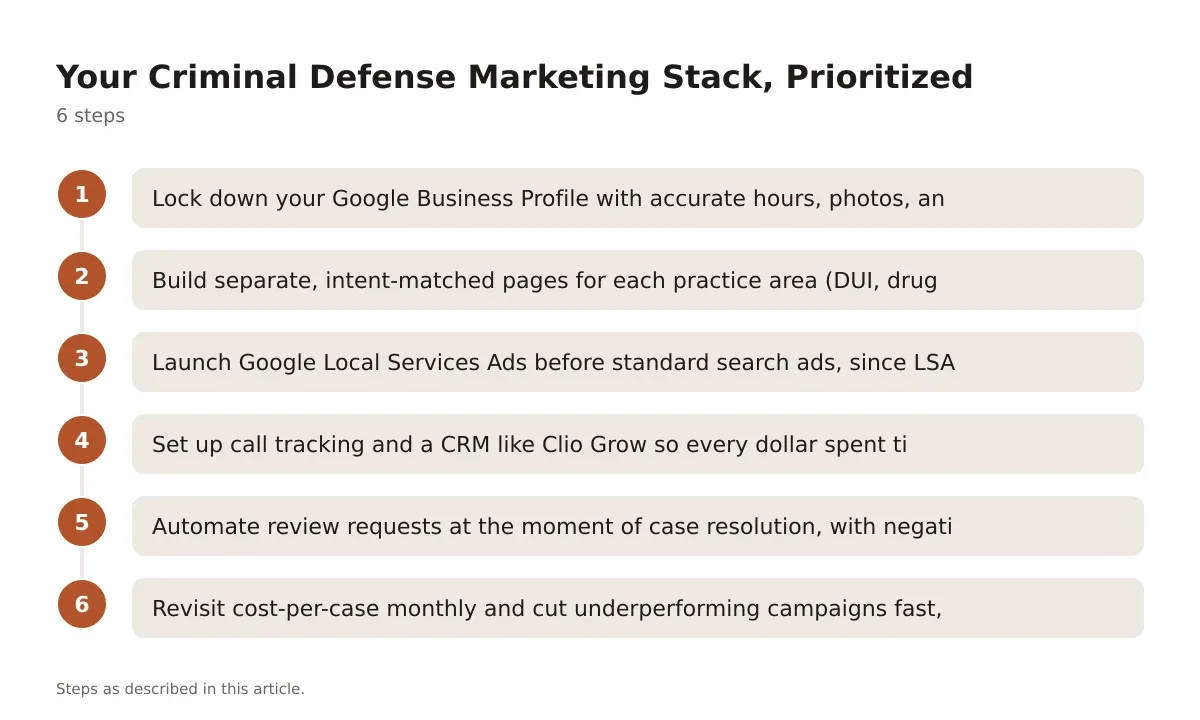
- Lock down your Google Business Profile with accurate hours, photos, and a review-response habit.
- Build separate, intent-matched pages for each practice area (DUI, drug crimes, assault, etc.), not one generic page.
- Launch Google Local Services Ads before standard search ads, since LSAs tend to have stronger intent-to-call conversion for arrest-related searches.
- Set up call tracking and a CRM like Clio Grow so every dollar spent ties back to a signed case.
- Automate review requests at the moment of case resolution, with negative feedback routed privately first.
- Revisit cost-per-case monthly and cut underperforming campaigns fast, criminal defense keywords are too expensive to run on autopilot.
Firms that skip step 4 are the ones who can’t tell you whether their marketing budget is working. That’s the most common failure point, not bad ad copy or weak content.
Building a Criminal Defense Law Firm Marketing Plan That Survives Slow Months
Criminal defense caseload is seasonal and unpredictable in ways most service businesses aren’t. DUI arrests spike around holidays; court backlogs shift intake timing by months. Your marketing plan has to absorb that volatility without panic budget cuts every time a quarter looks thin.
The firms that handle this best treat marketing spend like payroll, a fixed monthly commitment reviewed quarterly, not a dial they turn off the moment cash flow tightens. Cutting Google Ads spend the instant a slow month hits just guarantees an even slower month two months later, since paid leads take time to convert to signed retainers.
Build in a quarterly review: cost-per-case by channel, review volume and rating trend, and organic ranking movement on your top five practice-area pages. Adjust budget allocation based on that data, not gut feel. Criminal defense law firm marketing works when it’s treated as infrastructure you maintain, not a campaign you launch and forget.
Frequently asked questions
How much should a small criminal defense firm budget for marketing monthly?
Most small firms with two to four attorneys budget somewhere between $2,500 and $6,000 monthly across paid ads, SEO, and reputation tools, depending on market competitiveness. Metro markets with heavy DUI and drug charge competition push toward the higher end. Start smaller, track cost-per-case, then scale what’s working.
Are Google Local Services Ads better than traditional Google Ads for criminal defense?
LSAs often convert better because they’re pay-per-lead rather than pay-per-click, and Google vets the firm’s license before approving the listing. Traditional search ads still have a place for keywords LSAs don’t cover, like specific felony charge types. Most firms run both, weighted toward LSAs once approved.
Can criminal defense lawyers legally pay for referrals from bail bondsmen?
Fee-splitting arrangements with non-lawyers, including bondsmen, sit in a gray area and are restricted or banned under most state bar ethics rules. Check your specific state bar’s rules on referral fees and fee-splitting before relying on this channel. This is not legal advice, confirm with your state bar or ethics counsel.
What’s the fastest way to improve local SEO rankings for a criminal defense firm?
Consistent, accurate Google Business Profile management combined with steady review generation moves the needle fastest, usually within a few months. Pair that with practice-area-specific pages that answer real search questions rather than one generic services page. Schema markup and mobile site speed round out the technical side.
Should a solo criminal defense attorney hire an in-house marketer or use an agency?
Most solo and small firms get better value from a specialized legal marketing agency or freelance legal SEO consultant than a full-time in-house hire, since marketing needs fluctuate with caseload. An in-house hire makes more sense once monthly ad spend consistently exceeds the mid five figures. Either way, insist on reporting tied to signed cases, not just impressions or clicks.