
Immigration law firm marketing fails when it copies other practice areas. Do immigration clients really shop like every other legal client? They don’t. Instead, your buyers search in several languages, fear the wrong fee, and often hire on a relative’s say-so.
Immigration law firm marketing works when you match that behavior: language-specific search pages, trust built through community channels, and honest handling of scam fears. This guide covers what to build, what to skip, and how to measure it.
Why Immigration Law Firm Marketing Starts With the Buyer
Most practice areas sell to one person making one decision. Immigration sells to a family, often with a petitioner in one country and a beneficiary in another.
That changes your marketing. In practice, the person typing the search may not be the person who signs the retainer. A US citizen husband researches a spousal petition. His wife later joins the consultation. A tech employer’s HR manager searches for an H-1B sponsor lawyer, while the employee watches nervously.
Fear drives the search. After all, notario fraud is real. Prospects have heard stories of paid filings that vanished. Your first job is proving you are a licensed attorney, not a paper-filing shop.
Picture a three-lawyer firm in Houston. Its inquiries came from two groups: Spanish-speaking family petitioners and Indian-born engineers seeking employment green cards. Same firm, two audiences, two completely different message sets. Therefore, treat them as separate campaigns, each with its own landing page, intake script, and budget line.
Language and Community Channels in Immigration Law Firm Marketing
English-only marketing leaves money on the table. If your market includes Spanish, Mandarin, Tagalog, Hindi, or Arabic speakers, build real pages in those languages. Use a native translator, not machine output. Otherwise, prospects spot awkward legal phrasing instantly, and it kills trust.
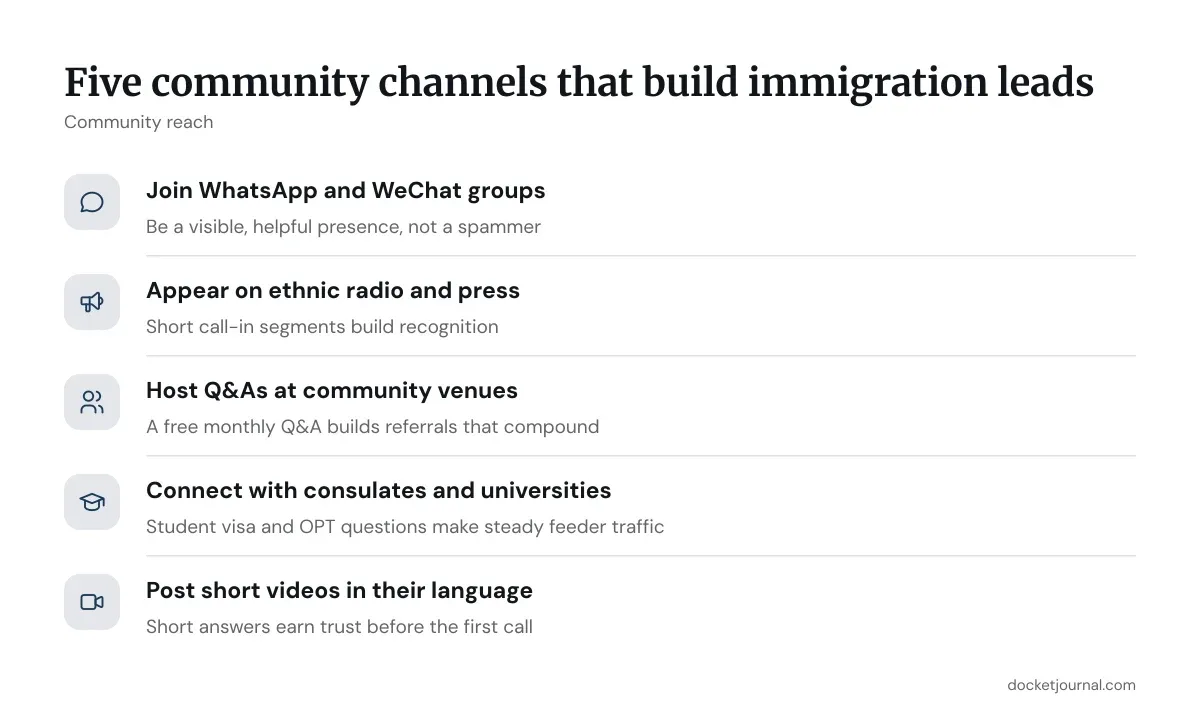
Community channels often beat paid search for cost per signed case:
- WhatsApp and WeChat groups. Prospects share lawyer names there constantly. Be a visible, helpful presence, not a spammer.
- Ethnic radio and local-language newspapers. Short call-in segments build recognition.
- Churches, mosques, temples, and cultural associations. A free monthly Q&A builds referrals that compound.
- Consulates and university international offices. Student visa and OPT questions make steady feeder traffic.
- YouTube and TikTok in the client’s language. Short answers about processing times or interview prep earn trust before the first call.
Take a solo practitioner in Queens who started a monthly Spanish-language Q&A at a community center. Within a year, most of her new family-petition clients mentioned those sessions at intake. In total, she spent a few hundred dollars on flyers and a room.
Above all, track each source from day one. Ask every caller, “How did you hear about us?” and log the answer in your CRM.
Pricing Transparency in Immigration Law Firm Marketing
Many immigration cases suit flat fees, and flat fees are marketing. A prospect afraid of surprise bills will favor the firm that publishes its pricing logic.
You don’t need a rate card for every case. In fact, even a clear range helps. Publish what a typical family petition includes: forms, document review, filing, and one RFE response. State what falls outside it, such as appeals or court appearances.
Compare two common approaches:
Option A: Hidden pricing, consultation-first
You ask prospects to book a paid consultation before they learn anything about cost. Conversion happens at the consult, where your lawyers do the selling. The downside is lost leads. Many families abandon the process because they assume fees are out of reach.
Option B: Published ranges, consultation second
You post fee ranges per case type and explain what shifts the price. Fewer people call, but those who do arrive pre-qualified. As a result, your intake staff spend less time on mismatched budgets.
Most firms find Option B cuts wasted consults. To begin, test it on one practice area first, such as family-based petitions, then compare signed-case rates after 90 days.
Whichever you choose, state your payment-plan policy openly. Many immigration clients can’t pay a full flat fee upfront. A written installment option removes a real barrier.
SEO Built Around Case Types, Not Generic Terms
Skip the broad “immigration lawyer” fight in a big metro. After all, large firms outspend you there. Build depth instead around specific case types and specific questions.
Create one strong page per matter: marriage-based green cards, K-1 fiancé visas, H-1B petitions, asylum, DACA renewals, naturalization, removal defense. Each page should answer the questions a nervous person actually types. How long does the interview take? What if my I-130 gets a request for evidence? Can I travel while my application is pending?
Use official sources to keep pages accurate. Link to USCIS for current form editions and fee schedules, and to the Executive Office for Immigration Review for court procedure. Immigration rules shift often, so put a visible “last reviewed” date on every page and revisit them on a schedule.
Set up your Google Business Profile carefully, and list the languages your staff speak. That detail drives clicks. For the general mechanics of local search, see our guide on filling a law firm pipeline. Here, focus on what’s unique: case-type pages and language signals.
Watch your claims. Never promise outcomes or timelines you can’t control. In addition, bar advertising rules apply, and state bars treat misleading immigration advertising harshly.
Paid Ads and Intake: Where the Money Leaks
Immigration is a competitive paid-search category, and clicks are expensive in major metros. Spend them on narrow, high-intent terms like “I-751 attorney” or “fiancé visa lawyer,” not broad phrases.
Tighten the funnel before raising the budget. In reality, calls come in at odd hours, often from people working two jobs. A firm that answers only from 9 to 5 loses them to the next ad.
Consider a Phoenix firm that spent about $4,000 a month on Google Ads but let roughly a third of calls roll to voicemail. After adding an answering service with Spanish-speaking agents and a text-back for missed calls, the same spend yielded noticeably more booked consults. The ads never changed. The intake did.
Fix these before buying more traffic:
- Answer or text back within five minutes.
- Offer intake in the caller’s language.
- Use online scheduling so prospects can book at midnight.
- Track call outcomes in a CRM like Clio Grow or Lawmatics, so you see which campaign produced a retainer, not just a call.
Measure cost per signed case, not cost per lead. In short, a cheap lead that never signs costs more than an expensive one that does.
Reputation and Trust Signals in Immigration Law Firm Marketing
Reviews matter more here than in most practice areas, because trust is the whole decision. Ask satisfied clients for a Google review at case approval, when relief is highest. To that end, make it easy: send a direct link by text.
Be careful with client confidentiality. Immigration status is sensitive, and many clients won’t want a public review at all. Never ask anyone to compromise their privacy. Respect refusals and rely on other proof.
Strong trust signals include:
- Bar number and attorney bios on every page
- Clear statements that you are a licensed attorney
- Memberships such as the American Immigration Lawyers Association
- Short, anonymized outcome descriptions, written within your bar’s rules
You can also meet the fraud fear head-on. A short page titled “How to tell a lawyer from a notario” ranks for real searches and positions you as the safe choice. That one page can outperform a dozen generic blog posts.
Never frame a post as legal advice. Keep content educational and invite readers to book a consultation for their own facts. If you want a structured approach to organizing all this work, our law firm marketing plan walks through the framework.
Building Your Immigration Law Firm Marketing Checklist
Immigration marketing rewards focus. You don’t need ten channels. You need two or three that match your clients’ real habits, plus an intake process that doesn’t leak.
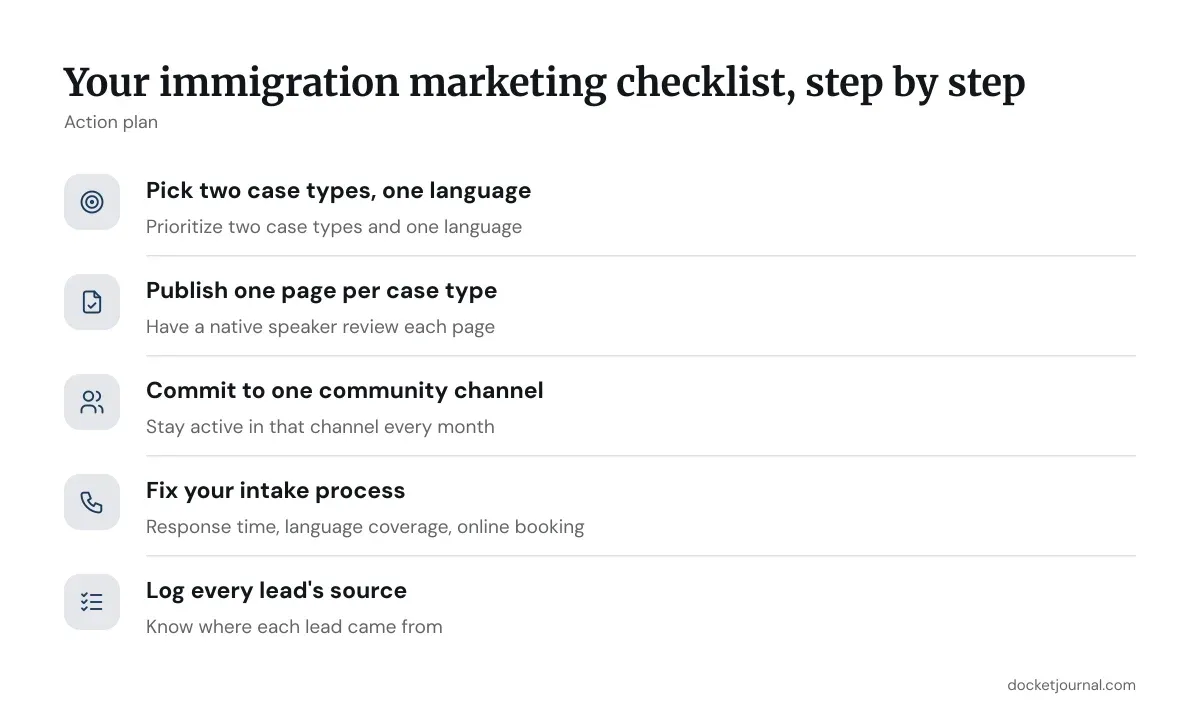
Start with a one-quarter plan:
- Pick two case types and one language to prioritize.
- Publish or rewrite one page per case type, reviewed by a native speaker.
- Choose one community channel and commit to monthly activity.
- Fix intake: response time, language coverage, online booking.
- Log the source of every lead.
Review the numbers at day 90. Cut what produced calls but no retainers. Double down on what produced signed cases. Small firms that spread a limited budget across every channel usually learn nothing, because no single effort gets enough weight to measure.
The honest truth is that immigration clients choose on trust, language, and clarity about cost. Technology amplifies those things but can’t replace them. Get the human basics right, and your ad dollars start working harder. For a broader view of channel choices and budgets, read our piece on where small firm budgets get wasted.
Remember that marketing rules vary by state, and this article is not legal advice. Check your bar’s advertising rules, especially around testimonials, specialization claims, and foreign-language ads, before launching anything.
Frequently asked questions
How much should an immigration law firm spend on marketing?
Many small firms budget between 5% and 15% of gross revenue, but the right figure depends on your growth goals and referral base. Start lower if referrals already feed your pipeline. Raise spend only after your intake converts leads reliably, and judge results by cost per signed case.
Can immigration lawyers advertise in other languages?
Yes, but bar rules still apply. Many states require that foreign-language ads carry the same disclosures as English ones. Some also require you to state which languages your staff actually speak. Check your state bar’s advertising rules before publishing, and have a qualified translator review every page.
Are testimonials allowed in immigration law marketing?
It depends on your jurisdiction. Several bars restrict testimonials or require disclaimers that past results don’t guarantee future outcomes. Immigration status also raises privacy concerns, so get written consent and never identify clients without permission. When in doubt, ask your bar’s ethics hotline.
What is the best marketing channel for immigration lawyers?
No single channel wins everywhere. Referrals and community presence often produce the highest-trust clients, while case-type SEO and narrow paid search capture active searchers. Test two channels at a time, track signed cases by source, and shift budget toward whichever performs.
Should my immigration firm publish flat fees online?
It often helps. Published ranges pre-qualify prospects and ease fears about hidden costs. You don’t need exact prices for every matter. A clear range per case type, plus a note on what’s excluded, is usually enough. Test it on one practice area and compare consultation-to-retainer rates.