
You have a quiet pipeline, a partner asking what marketing is doing, and a budget that cannot absorb another experiment that goes nowhere. Most lists of law firm marketing ideas hand you fifty tactics with no way to pick one.
This article gives you a smaller set. Each idea comes with a cost range, a time frame, and a way to tell whether it worked. For the broader channel picture, see our general guide to law firm marketing.
Law Firm Marketing Ideas: Which Type Fits Your Firm
Marketing ideas fall into three types. Capture ideas catch people already searching for a lawyer. Referral ideas make existing relationships produce more work. Authority ideas build the reputation that makes both of the others convert.
Picture a three-partner family law firm in a mid-size city. It has strong word of mouth but no website that reflects it. For that firm, a capture idea (fixing its Google profile) beats an authority idea (starting a podcast) by a wide margin.
Pick your type by asking where your best matters came from last year. If you cannot answer, that is your first project. Pull the intake log, tag each matter by source, and count. Ten minutes in a spreadsheet will tell you more than any list of tactics.
Low-Cost Law Firm Marketing Ideas You Can Start This Month
These cost almost nothing but time. They suit a firm that has no marketing budget yet or wants quick proof before committing money.
- Claim and complete your Google Business Profile. Add every practice area, real office photos, and business hours. Ask three recent clients for reviews this week.
- Write one client-question page per practice area. Use the questions intake staff hear weekly, such as “how long does probate take here?”
- Add a call-back promise to your contact form. “We respond within two business hours” lifts form completion because it removes uncertainty.
- Send a short quarterly email to past clients. One useful tip and a line saying you take referrals. Past clients are your cheapest audience.
- Audit your intake call handling. Call your own firm at 6 p.m. on a Tuesday. If it rings out, no advertising idea will save you.
Pick two, not five. A firm that finishes two small projects beats one that starts five.
Referral Ideas That Turn Relationships Into Matters
Referrals come from lawyers and professionals who trust you with their clients. Most firms treat this as luck. It works better as a routine.
Consider an estate planning boutique that wants more business from financial advisors. It lists ten local advisors and CPAs, then books one coffee a month with each. At every meeting it asks one question: what do your clients struggle with that a lawyer could solve? Within a year, two or three of those relationships typically become steady sources.
Build a simple tracker with four columns: referrer, last contact, matters sent, matters received. Review it monthly. The goal is reciprocity, so send work back when it fits.
Add one formal step. When a referral lands, send a handwritten thank-you within 48 hours, and update the referrer on the outcome only as far as confidentiality allows. Referrers who feel appreciated refer again. Those who hear nothing drift away.
For a structured approach to reputation and referral programs, our law firm marketing plan walks through the tracking side.
Content-Led Law Firm Marketing Ideas That Bring Inquiries
Content works for law firms when it answers a specific search, not when it fills a blog calendar. The test is simple: would a person in trouble type this exact phrase into Google?
A small employment firm might skip “Workplace Law Trends” and write “Can my employer cut my commission after I’ve earned it?” That page matches a real search with real urgency. It also qualifies the reader, because the people searching are the people who need you.
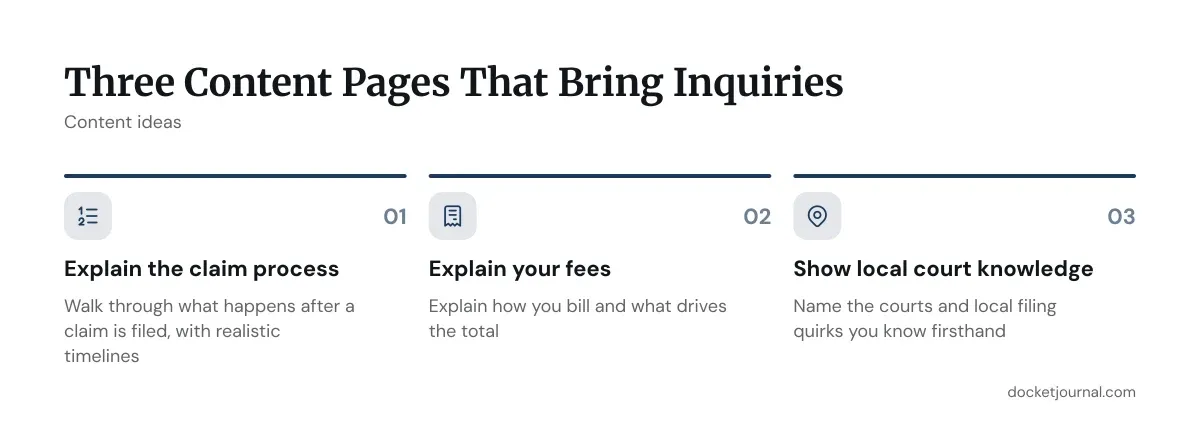
Three formats earn their keep:
- Process explainers. Walk through what happens after a car accident claim is filed, step by step, with realistic timelines.
- Cost and fee pages. Explain how you bill (flat fee, hourly, contingency) and what drives the total. Few firms do this, so it differentiates you.
- Local-angle pages. Name the courts, judges’ scheduling habits, and local filing quirks you know firsthand.
Skip anything that reads like a legal encyclopedia. A partner should review each page for accuracy, but write for a stressed reader, not a law review. Add a clear next step at the bottom: call, book a consultation, or download a checklist.
Paid and Partnership Ideas Worth a Small Test
Paid ideas carry risk, so cap the test. Set a fixed budget for 90 days and define the success number before you spend. Check the wording of any ad against the ABA rule on communications concerning a lawyer’s services before the campaign goes live.
Google Ads on high-intent searches is the usual starting point. Legal clicks are expensive, so a tight keyword list and a dedicated landing page matter more than volume. If a signed matter is worth $6,000 to your firm and you close one in five consultations, you can work backward to what a consultation is worth to you.
Two less obvious ideas deserve a look. Sponsor a local bar association event or a small-business breakfast, where your name sits in front of people who hire lawyers. Or co-host a free workshop with a non-legal partner, such as a family law attorney with a financial planner on divorce preparation.
Whatever you test, track it. Use a unique phone number or a “how did you hear about us?” question on every intake. Without attribution, you will end up funding whichever idea the loudest partner likes. Our piece on why small firm budgets get wasted on the wrong channel covers the common traps.
How to Rank Law Firm Marketing Ideas Without Guessing
You now have more ideas than capacity. Score each one on four points: cost, time to first result, effort from your team, and fit with your best client type. Give each a score from one to five, then total them.
A simple scoring sheet looks like this:
- Idea name and owner
- Estimated monthly cost
- Weeks until you would see a signal
- Hours of staff time required
- The single metric that proves it worked
Run no more than three ideas at once. Review each at 30, 60, and 90 days. Kill anything that misses its metric without a good reason, and double down on whatever produces signed matters, not just clicks or likes.
Assign every idea one owner. Marketing that belongs to “the partners” belongs to no one, and it stalls the first time billable work gets busy. Block two recurring hours a week for whoever owns it.
Turning Ideas Into a Routine
Good law firm marketing ideas share one trait: someone owns them and someone measures them. A modest idea run consistently for a year beats an impressive one abandoned in week six.
Start with your intake log, choose the two or three ideas that match where your best clients already come from, and set a metric for each. Fix the leaks before you add new channels, because a missed call costs more than any ad.
When these ideas start to work, fold them into a written plan the whole firm follows. Our framework for building that plan shows how to organize it.
Check your jurisdiction’s advertising and solicitation rules before launching anything, since they vary by state and bar. This article is general information, not legal advice.
Frequently asked questions
What is the cheapest law firm marketing idea that still works?
Completing your Google Business Profile and asking recent clients for reviews. It costs only time, and it targets people already searching for a lawyer near them.
How long before a marketing idea shows results?
Referral and review ideas can show a signal in four to eight weeks. Content typically needs three to six months. Paid search can produce inquiries within days, though it takes a few weeks of adjustment to become efficient.
How many marketing ideas should a small firm run at once?
Two or three. More than that spreads your team thin and makes it impossible to tell what is working. Finish and measure a small set before adding more.
How do I know which idea brought in a client?
Ask at intake, every time, and log the answer. Pair that with a tracked phone number or a dedicated landing page for any paid test. Review the log monthly.
Are law firm marketing ideas different for solo practitioners?
The ideas are the same, but the capacity is not. A solo should favor referral relationships and one strong local page over anything needing weekly output. Choose ideas you can sustain alongside billable work.